
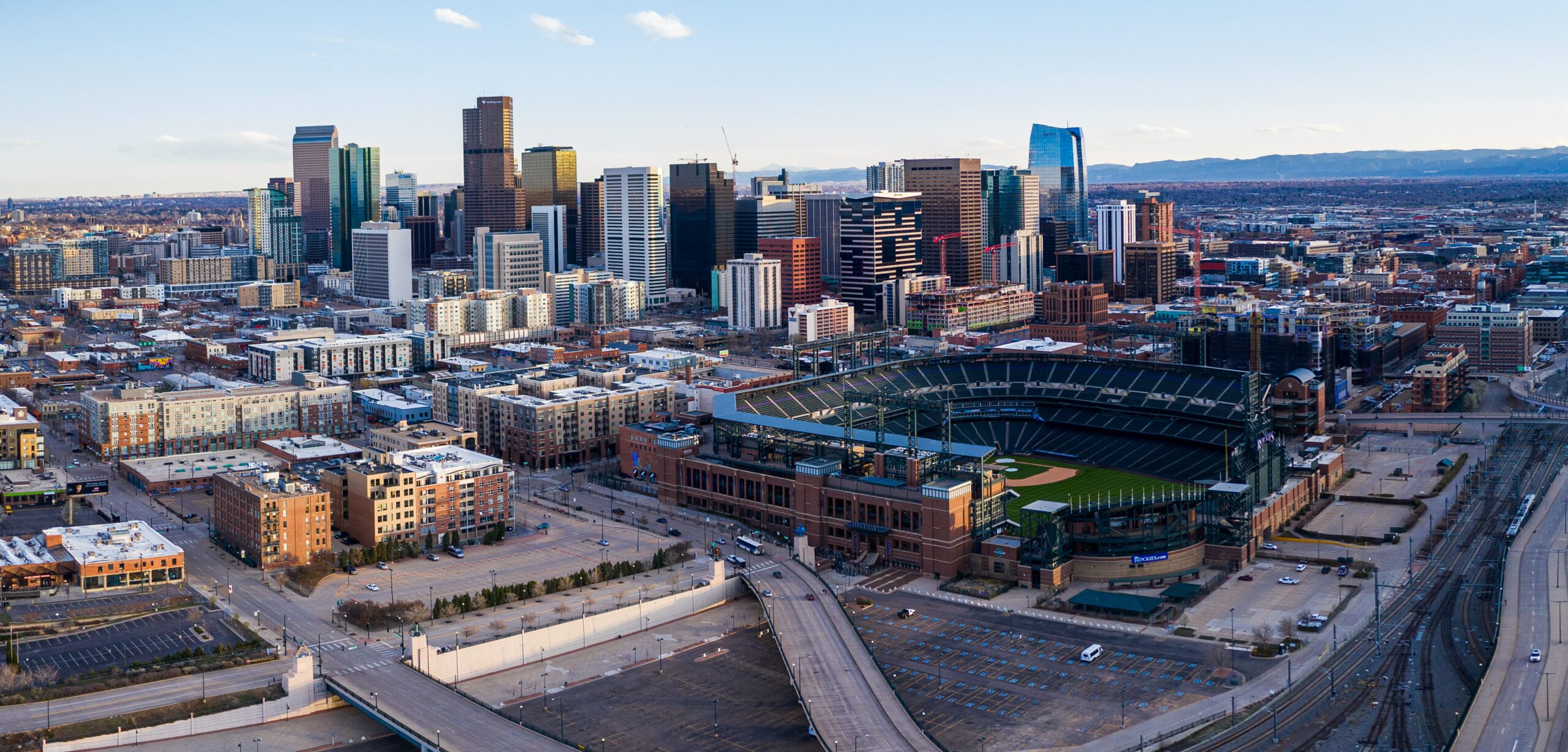
Office Sector
Challenges remain for Denver’s office market heading into the middle of 2025 as tenants continue to evaluate their office requirements and office-using job growth slows. Denver’s vacancy rate has reached a record 17.9%, and annual net absorption of -2.2 million SF remains firmly negative, even as about half of major markets across the country have seen annual net absorption rebound into positive territory. Still, early positive signs are emerging, including a slowdown in tenant vacancies, limited supply pressure, and steady leasing activity. Combined, these indicators suggest that the market could stabilize in the year ahead, provided that the current volatile economic climate does not derail the recent momentum.
Office availability is likely to remain elevated in Denver for some time, as current leasing trends suggest that companies are adjusting their footprints to lower space-per-worker requirements when their leases expire. Leases signed in 25Q2 averaged about 3,200 SF, representing a 40% decrease in average lease size since its peak in 2015.
Annual negative net absorption has become less broadbased across the market, with about half of submarkets trending in negative territory, compared to nearly all submarkets reporting negative annual net absorption in early 2024. Denver has a high concentration of older buildings which have borne the brunt of softening demand. This subset includes some of Denver’s most iconic buildings in downtown that have struggled to maintain adequate cash flows as tenants vacate. Denver’s CBD maintains the highest vacancy rate of 31% with 3.8 million SF vacated since the start of 2020. However, move-outs have slowed in the urban core, with just 100,000 SF of negative net absorption recorded in the past year.
Supply-side pressure will be less of an issue going forward. About 1.6 million SF is under construction, down from the five-year pre-pandemic verage of 3.5 million SF. Apart from a few notable exceptions, speculative development has slowed as developers continue to face difficulties in obtaining financing for new projects.
With the abundance of available space, the Denver office market remains tenant-favorable. While base asking rents have held relatively steady since the beginning of 2021, tenants have maintained leverage in lease negotiations by asking for steep concessions and higher tenant improvement allowances. Additionally, tenants can get a 30% discount on built-out sublease space relative to direct space.
Net absorption should continue to improve through the year, as most companies have already set their expectations for office attendance and have adjusted their footprints accordingly. There’s potential for Denver’s vacancy rate to stabilize by year-end, though economic upheaval could stall the office market’s recovery.
Industrial Sector
Denver’s industrial market stabilized in the past year as a slowdown in new construction completions coincided with an uptick in tenant demand. Still, the market remains more in tenants’ favor due to the development surge between 2021 and 2023 that led to the sharpest vacancy expansion of the last decade. While the vacancy rate is not expected to rise much higher, at 8.8%, it is among the highest of any major U.S. market. The vacancy rate will likely remain elevated through the first half of 2025 as landlords work through the supply overhang.
Tenant demand accelerated in the past year along with key positive economic data, including an uptick in consumer confidence and wage growth rising above inflation. Most recent leases are in the East I-70 corridor, an area of Denver that offers convenient access to major highways, rail, and Denver International Airport, as well as proximity to a skilled labor force.
Roughly 5.0 million SF is under construction, the lowest figure dating back to 2017. Following national trends, developers have pulled back on construction starts amid higher rates and tighter lending requirements for construction loans. Over the past four quarters, local industrial construction starts have totaled only 1.6 million SF, down 85% from peak levels in 2022 and 60% below the pre-pandemic five-year average. This is setting the stage for fewer completions this year.
Denver’s industrial market will need to contend with an excess of available space before rent growth can recover to pre-pandemic norms. With vacancies expected to remain elevated in the near term, rent growth is projected to decelerate. However, the pullback in construction activity should limit additional supply pressure from hitting the market this year. With space availability likely to begin to tighten again later this year, there’s potential for rent growth to accelerate during 2025-26.
Small bay properties are set to outperform, as the market remains dominated by small and midsize distribution tenants that serve the local population. With developers focused on bulk distribution centers in recent years, less new construction has been built to serve smaller tenants, and small bay properties remain in high demand with space listings that typically only last less than five months.
Retail Sector
As of 25Q2, Denver’s retail market continues to benefit from an exceptionally low availability rate, limited new construction, and a resilient consumer base. This comes despite longstanding concerns of a softening economy and Denver’s slower population growth.
Retail availability has hit a near-record low of 4.7%, coming in below the 10-year average of 5.3%. Low availability is beginning to impact leasing activity as tenants face challenges securing the right type of space. On the smaller end of the market, national chains, including quick-service restaurants, convenience stores, and banks, are driving leasing activity. In larger formats, experiential tenants were key drivers of demand, as reflected in the top leases signed in the first half of the year.
Denver’s construction pipeline remains subdued, and the projects that move forward overwhelmingly consist of freestanding build-to-suits. Retail inventory has grown at the slowest pace of all major asset types in Denver, helping to restore balance in the market.
While availability and new construction remain minimal, retail rents have barely risen over the past year, up by 2.5%, slightly above the national benchmark of 1.8%. When adjusting for inflation, rent growth in real terms is in negative territory. This trend contradicts the tight fundamentals that should support robust rent growth. However, market participants note that Denver has a high concentration of locally-owned retail establishments. Landlords can only push rates to a certain extent before it becomes economically unfeasible for these tenants.
In the current high-interest rate environment, the buyer pool has shifted predominantly to small private investors who target single-tenant net-leased deals valued under $5 million. Cap rates in this tier tend to be on the lower end of the spectrum but have generally moved upward since the beginning of 2022 by about half a percentage point and now average in the mid-5% range. The number of deals closing above $5 million is limited, with the largest deals in the past year focused on value-added plays with higher cap rates owing to the heightened risk in this tier and the more management-intensive nature of these assets.
Denver’s retail market is projected to remain tight through 2025 due to limited new construction and positive demand. Retail sales growth has outperformed in recent years, indicating that retailers are doing more with less by focusing on efficiency in this continuously evolving sector.
Denver Economic Outlook
As Denver enters the second quarter of 2025, its economic outlook is mixed. The city continues to benefit from a diversified economy, with strong sectors like technology, healthcare, and logistics. The tech industry, in particular, is thriving, boasting a 12.6% job growth rate and average salaries significantly above the metro average . However, the broader economic environment is marked by caution. Colorado is experiencing a “new era of austerity,” characterized by flat population growth, slowing job growth, and declining sales tax collections . These factors contribute to an atmosphere of uncertainty, prompting businesses and investors to adopt a more conservative approach.Connexions Solutions Axios
In the commercial real estate sector, the office market remains under pressure. Vacancy rates in Denver are among the highest in the nation, with the central business district experiencing particularly elevated levels . This trend is largely due to the persistence of remote and hybrid work models, leading companies to downsize their physical footprints. However, there are signs of stabilization, especially in submarkets like Cherry Creek, where demand for high-quality, amenity-rich spaces remains strong . Additionally, efforts to revitalize downtown Denver, including plans to convert underutilized office buildings into residential units, aim to address the oversupply and invigorate the urban core.Axios Corken Paramount Property Tax Appeal NorthPeak Commercial Advisors
The multifamily housing market is experiencing challenges due to an oversupply of units. In the past year, 17,524 new units were delivered, while only 9,143 were absorbed, pushing overall vacancy to 11.3%—a 20-year high . This has led to a decline in asking rents and increased concessions to attract tenants. However, the slowdown in new construction starts suggests that supply-side pressures may ease later in 2025, potentially leading to more stable rent growth . Meanwhile, the industrial real estate market remains robust. Despite a temporary increase in availability due to a surge in new construction, demand continues to outpace supply, particularly in logistics and e-commerce sectors . This resilience positions Denver’s industrial market for continued strength in the coming quarters.Corken NorthPeak Commercial Advisors Corken Corken NorthPeak Commercial Advisors Corken